Customer portal
A login where customers see documents, status, and history without emailing to ask.
- Replaces
- Email threads and phone calls asking for updates
- Typically includes
- Authentication, document storage, status feeds, notification rules
Service 02
Software built to specification where no off-the-shelf product fits the process.
Projects in this column get flagged in the first conversation, not after discovery is paid for.
Paid, and credited to the build. The work is mapped as it actually happens.
Output
Written scope, fixed price, timeline.
A number and a date before any code is written. No hourly surprises.
Output
A signed scope to hold us to.
Working software every week, so course corrections happen early and cheaply.
Output
Working software, weekly.
Runbook, documentation, and the code itself.
Output
Code, data, and docs in your accounts.
Discovery is credited to the build. If it concludes that nothing should be built, you keep the written analysis and owe nothing further. That outcome is a success, not a failed sale.
Product demonstrations using sample data.
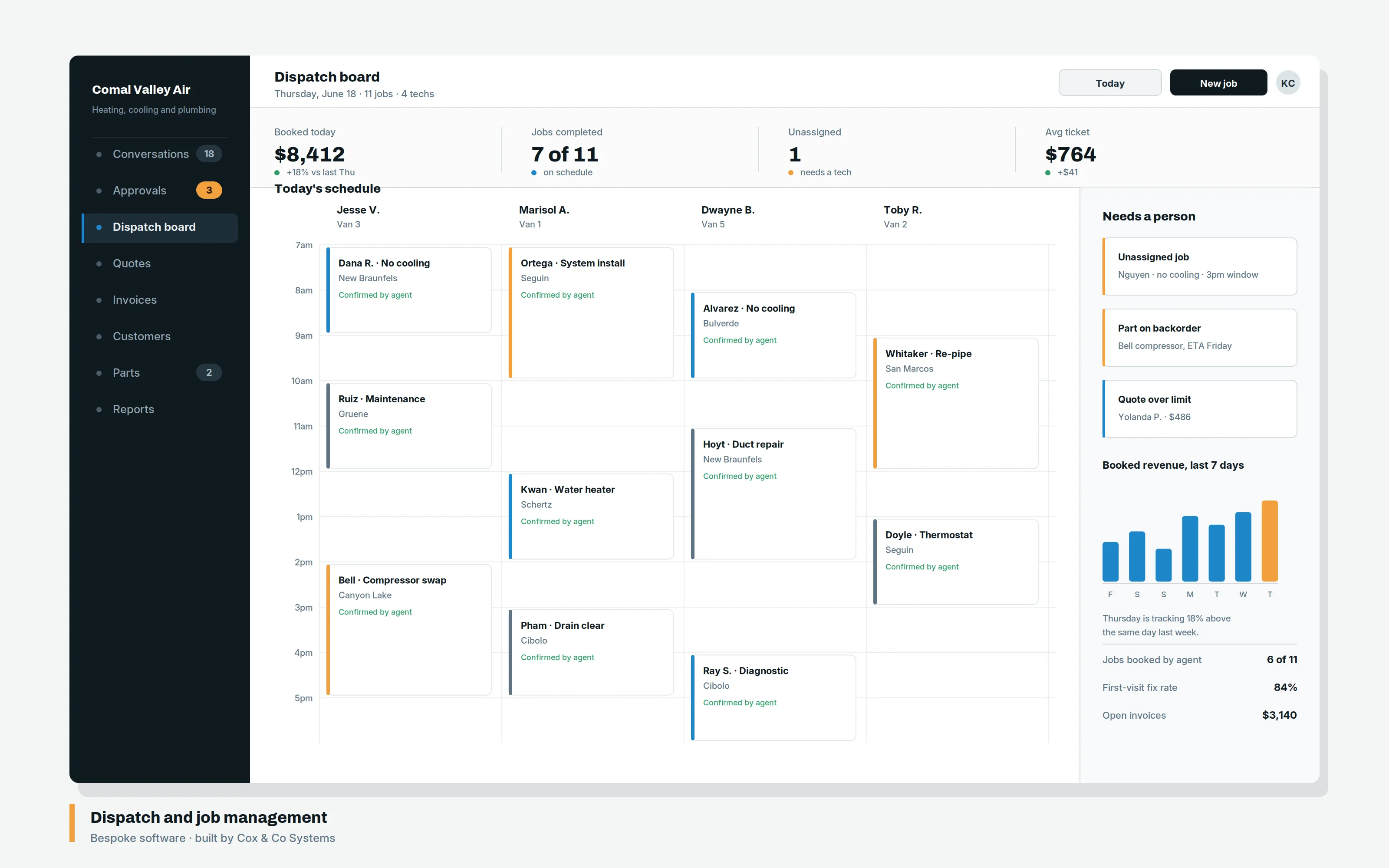
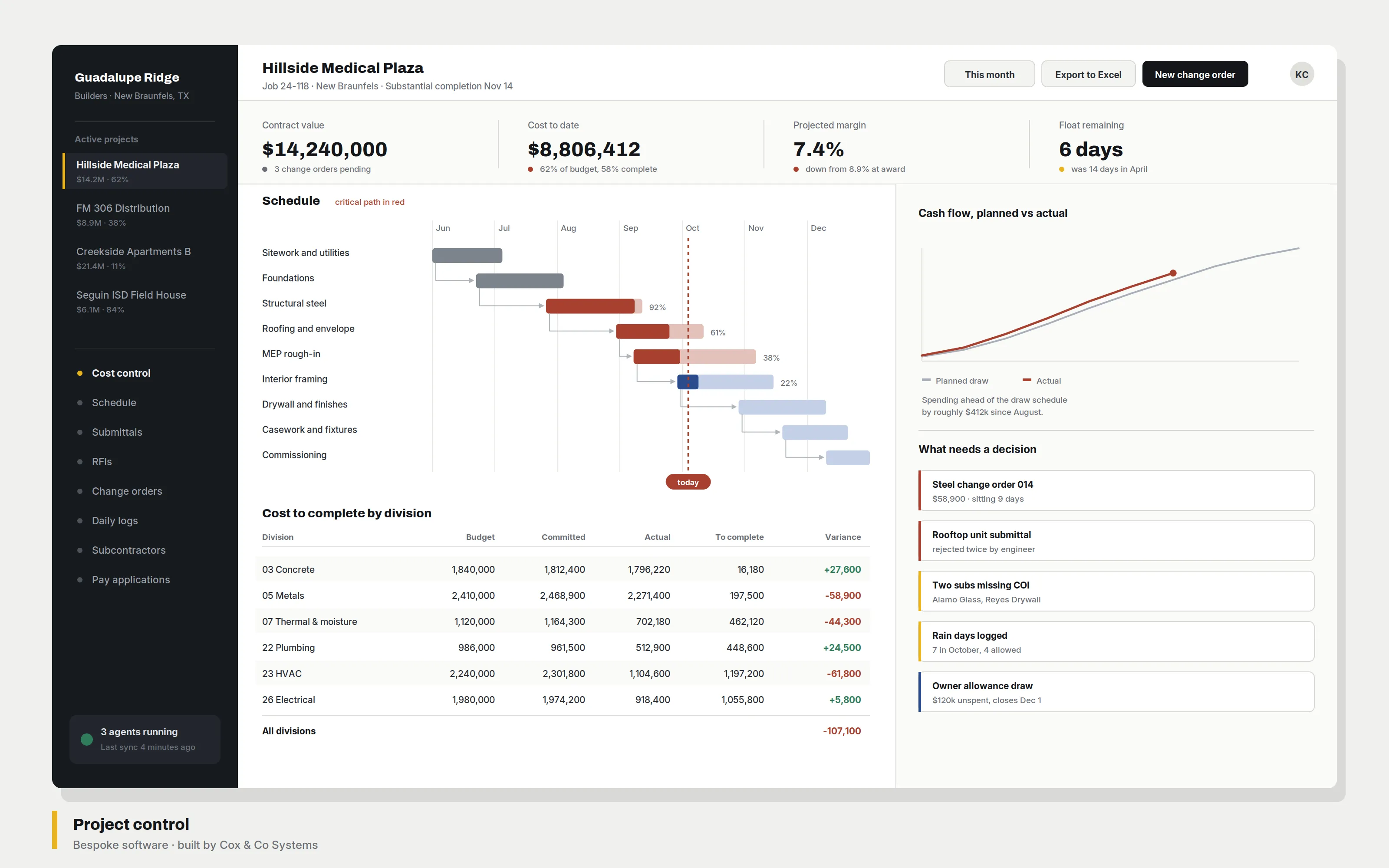
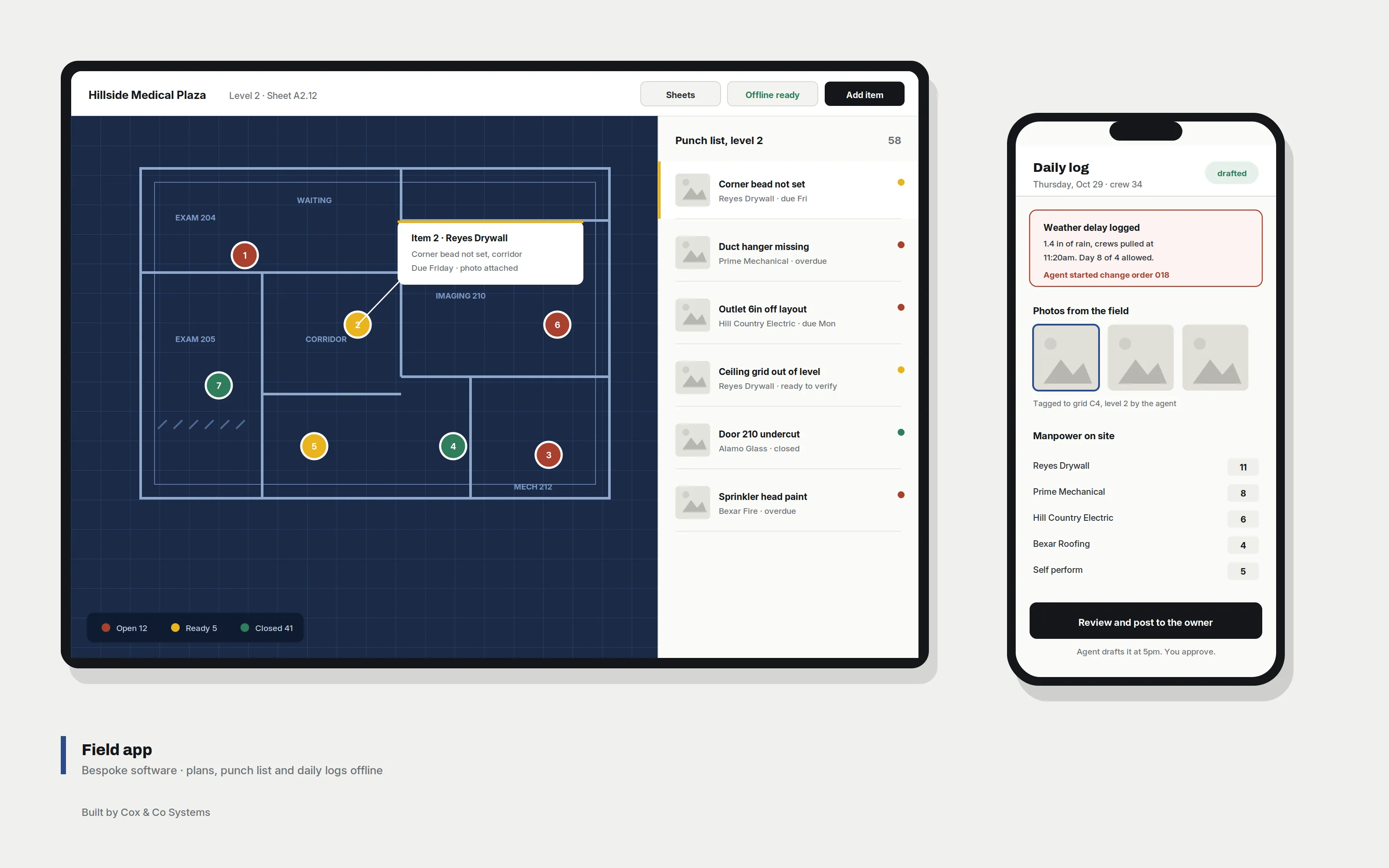
Project control, the agent console, the field app and the workflow that ties them together.
Product demonstration using sample data.
The three that come up most often. Each is scoped and quoted individually.
A login where customers see documents, status, and history without emailing to ask.
A live view of jobs, crews, and status, updating as work moves.
Structured pricing so quotes go out in minutes and come back consistent.
Internal software is built and supported by the same engineer throughout.
Internal tools are held to a different standard than marketing sites. Once a team runs the business on a system, data integrity and availability stop being optional.
Work is not reassigned to junior staff after signing. The engineer present at discovery writes the software and supports it.
FAQ
The client owns the code and the data. Cox & Co retains rights to reusable components only, and grants an unrestricted licence to those as part of the delivered work. The repository sits in an account registered to your business from day one, not handed over at the end.
Hosting, monitoring, and support are quoted alongside the fixed build price, scaled to the size of the system. That covers infrastructure, security updates, uptime monitoring, backups, and support.
This is the question worth asking and most firms dodge it. Everything runs in your accounts, the code is documented, and a written runbook covers deployment, environment variables, backups, and recovery. A paid handover to a developer of your choosing is available.
Discovery takes one to two weeks. Most internal tools then land between six and twelve weeks, with working software demoed weekly. The scope document carries a fixed date, not an estimate that drifts.
Dependency and security updates, monitoring and responding to failures, backups verified rather than assumed, and small changes as the process shifts. Larger features are quoted separately.
Because a free quote on custom software is a guess, and guesses get corrected later at the client’s expense. Discovery buys a real investigation and produces a written scope, fixed price, and timeline. If the honest conclusion is to build nothing, you have paid a small amount to avoid a large mistake.
Usually, and this will be stated. Custom software is the expensive answer and goes last. It is right when a process is genuinely specific and no product fits without contorting the business around the tool.
That is what discovery is for, and concluding you should not build is a valid result.
Or call 512-522-6123